🏛️ The Turathium Rarity Scale (TRS) <div lang="en">
<style type="text/css">h1, h2 { color: #E2552D; }
table { width: 100%; border-collapse: collapse; margin-bottom: 20px; }
th, td { border: 1px solid #ddd; padding: 8px; }
th { background-color: #f2f2f2; }
ul { list-style-type: disc; margin-left: 20px; }
b { font-weight: bold; }
</style>
<h1>🏛️ The Turathium Rarity Scale (TRS)</h1>
<h2>Overview</h2>
<p>The <strong>Turathium Rarity Scale (TRS)</strong> is a structured and nuanced framework designed to assess and communicate the rarity of collectible cultural heritage objects. Developed by Turathium™ to serve the needs of scholars, collectors, and institutions alike, the TRS provides a precise yet intuitive method for evaluating an item's scarcity. It supports critical activities such as cataloging, research, authentication, appraisal, valuation, and collector engagement across diverse media types—including postcards, medals, coins, photographs, and paper ephemera.</p>
<p>The TRS comprises a <strong>Core Four-Level Scale</strong>, which is broadly applicable and easy to grasp, and an <strong>Expanded Twelve-Level Scale</strong>, which offers finer distinctions based on more precise survivor estimates. Together, these scales enable consistent and meaningful classification of item rarity across various disciplines and collecting communities, fostering clearer communication and a deeper understanding of cultural heritage.</p>
<hr class="separator" />
<h2>Core Four-Level TRS</h2>
<table>
<thead>
<tr>
<th>Level</th>
<th>Label</th>
<th>Estimated Survivor Range</th>
<th>Qualitative Description</th>
<th> </th>
</tr>
</thead>
<tbody>
<tr>
<td>A</td>
<td>Unique</td>
<td>0 - 9</td>
<td>Singular or nearly singular; represents ultimate rarity.</td>
<th style="background-color:red;"> </th>
</tr>
<tr>
<td>B</td>
<td>Rare</td>
<td>10 - 99</td>
<td>Few survivors; highly prized and challenging to locate.</td>
<th style="background-color:orange;"> </th>
</tr>
<tr>
<td>C</td>
<td>Scarce</td>
<td>100 - 999</td>
<td>Clearly limited; sought after by collectors.</td>
<th style="background-color:Green;"> </th>
</tr>
<tr>
<td>D</td>
<td>Uncommon</td>
<td>1,000 - 9,999</td>
<td>Found occasionally; accessible with effort.</td>
<th style="background-color:blue;"> </th>
</tr>
</tbody>
</table>
<p>The four main TRS levels (A-D) follow a logical alignment with <strong>orders of magnitude</strong>. This intuitive correlation simplifies memorization and reinforces the numerical logic of the TRS system:</p>
<ul>
<li><strong>A</strong> for Single-Digit Survivors (1-9)</li>
<li><strong>B</strong> for tens (10-99)</li>
<li><strong>C</strong> for hundreds (100-999)</li>
<li><strong>D</strong> for thousands (1,000-9,999)</li>
</ul>
<hr class="separator" />
<h2>Expanded Turathium Rarity Scale (12-Level)</h2>
<table>
<thead>
<tr>
<th>Level</th>
<th>Label</th>
<th>Estimated Survivor Range</th>
<th>Qualitative Description</th>
</tr>
</thead>
<tbody>
<tr>
<td>A+</td>
<td>No Known Survivors</td>
<td>0</td>
<td>No verified surviving examples; presumed lost or unrecorded.</td>
</tr>
<tr>
<td>A*</td>
<td>Unique</td>
<td>1</td>
<td>Singular item; the only known survivor or unique instance.</td>
</tr>
<tr>
<td>A−</td>
<td>Near Unique</td>
<td>2 - 9</td>
<td>Nearly singular; exceptionally rare with only a few known examples.</td>
</tr>
<tr>
<td>B+</td>
<td>Very Rare</td>
<td>10 - 24</td>
<td>Extremely hard to find; often the highlight of advanced collections.</td>
</tr>
<tr>
<td>B*</td>
<td>Mid Rare</td>
<td>25 - 49</td>
<td>Firmly rare; a serious challenge to acquire for collectors.</td>
</tr>
<tr>
<td>B−</td>
<td>Near Rare</td>
<td>50 - 99</td>
<td>Rare, but with slightly higher survival than typical rare-tier items.</td>
</tr>
<tr>
<td>C+</td>
<td>Very Scarce</td>
<td>100 - 249</td>
<td>On the high end of scarcity; often noticed by specialized collectors.</td>
</tr>
<tr>
<td>C*</td>
<td>Mid Scarce</td>
<td>250 - 499</td>
<td>Clear scarcity; interest maintained in many subfields of collecting.</td>
</tr>
<tr>
<td>C−</td>
<td>Near Scarce</td>
<td>500 - 999</td>
<td>Lower bound of scarcity; more frequently encountered but still less than uncommon.</td>
</tr>
<tr>
<td>D+</td>
<td>Very Uncommon</td>
<td>1,000 - 2,499</td>
<td>On the cusp between common and scarce; selectively sought.</td>
</tr>
<tr>
<td>D*</td>
<td>Mid Uncommon</td>
<td>2,500 - 4,999</td>
<td>Mid-range uncommon; often overlooked unless part of a niche category.</td>
</tr>
<tr>
<td>D−</td>
<td>Near Uncommon</td>
<td>5,000 - 9,999</td>
<td>Frequent appearances but marginally lower than common availability.</td>
</tr>
</tbody>
</table>
<h3>Usage Guidance: When to Use the Expanded Scale</h3>
<p>The <strong>Expanded TRS</strong>, with its granular modifiers (Near, Mid, Very), should only be used when the <strong>estimated number of surviving items is known with sufficient precision</strong> to place the object confidently within a specific subrange (e.g., between 250 and 499, or 100 and 249 survivors).</p>
<p>For most cataloging and research purposes—especially when survivor estimates are approximate or uncertain—the <strong>Core TRS</strong> provides an effective and robust classification system. <strong>It is crucial to avoid applying the Expanded TRS when data is speculative, as this can lead to misleading precision and undermine the system's integrity.</strong></p>
<h3>Summary of Use</h3>
<ul>
<li>✅ Use the Core TRS when survivor estimates are broad.</li>
<li>✅ Use the Expanded TRS only when strong evidence supports a precise rarity estimate.</li>
<li>❌ Avoid using expanded modifiers when data is insufficient or misleading.</li>
</ul>
<p>This approach ensures <strong>clarity, integrity, and reliability</strong> in rarity classifications while avoiding artificial precision.</p>
<hr class="separator" />
<h2>📊 Special Classification Tiers (Beyond Core Rarity)</h2>
<p>These tiers classify items that fall outside the core A-D rarity range. While the labels <b>"Common"</b> and <strong>"Unknown</strong>" describe broader rarity conditions, the <strong>specific notations</strong> used within the Turathium Rarity Scale (TRS) are <strong>TRS E</strong> and <strong>TRS X, </strong>respectively.</p>
<table>
<thead>
<tr>
<th>Level</th>
<th>Label</th>
<th>Estimated Survivor Range</th>
<th>Qualitative Description</th>
</tr>
</thead>
<tbody>
<tr>
<td>E</td>
<td>Common</td>
<td>> 9,999</td>
<td>Widely available; abundant survivals tracked outside core TRS tiers.</td>
</tr>
<tr>
<td>X</td>
<td>Unknown</td>
<td>Unknown</td>
<td>Rarity cannot be determined due to insufficient or inconclusive data.</td>
</tr>
</tbody>
</table>
<h3>🧩 Abundant Survivals (TRS E)</h3>
<p><strong>Tier E</strong> of the Turathium Rarity Scale (TRS) is reserved for items with <strong>more than 9,999 surviving specimens</strong>. While this tier lies outside the core rarity range (A-D), its notation as <strong>TRS E</strong> provides a consistent classification framework for items that are <strong>widely available</strong> yet still collectible or documented. Most recent circulating coins, for example, would fall within <strong>TRS E</strong>.</p>
<p>When precise counts are available—such as official print runs or mintages—<strong>TRS E</strong> may be used with <strong>operators </strong>(See <em>Using Operators with TRS Levels</em> below):</p>
<ul>
<li><code>TRS E=20,000</code> → Exactly 20,000 known survivors</li>
<li><code>TRS E≥50,000</code> → At least 50,000 survivors</li>
</ul>
<p>This tier ensures that abundance is still captured in structured metadata and cataloging systems.</p>
<h3>❓ Unknown Rarity (TRS X)</h3>
<p><strong>Tier X</strong> is reserved for items whose rarity is <strong>unknown or undetermined.</strong> While this tier also lies outside the core rarity range (A-D), its notation as <strong>TRS X</strong> ensures a consistent classification for cases lacking sufficient data. This designation is appropriate when:</p>
<ul>
<li>The item is in early-stage cataloging.</li>
<li>Reliable data is missing or inconclusive.</li>
<li>No credible estimate of surviving specimens can be made.</li>
</ul>
<p>For example, the rarity of a painting like "Madonna of the Streets" is classified as <strong>TRS X</strong> within the Turathium system, as its' current status and fate is entirely unknown. <strong>TRS X</strong> flags such entries for <strong>future research or review</strong>, while preserving their place in the system.</p>
<hr class="separator" />
<h2>Notes</h2>
<ul>
<li>The TRS is <strong>medium-agnostic</strong>: it can be applied to any type of cultural heritage item—postcards, coins, medals, photographs, prints, ephemera, etc.—with appropriate adaptation.</li>
<li><strong>Survivor estimates</strong> should be grounded in the best available data, including:
<ul>
<li>Auction and dealer records</li>
<li>Institutional and private collection inventories</li>
<li>Fieldwork and empirical surveys</li>
<li>Scholarly publications and <em>catalogues raisonnés</em></li>
</ul>
</li>
</ul>
<hr class="separator" />
<h2>➕ Using Operators with Core TRS Levels</h2>
<p>In cases where the estimated number of surviving specimens is <strong>precisely known</strong> or <strong>bounded with accuracy</strong>, TRS levels may be expanded with mathematical operators to express this granularity.</p>
<h3>Declaring an Accurate Upper Bound</h3>
<p>Use the <strong>"less than"</strong> operator (<) after a core TRS level to indicate a <strong>known upper limit</strong> on the number of surviving specimens.</p>
<ul>
<li><strong>Notation:</strong> <code>TRS B<20</code> → <strong>Meaning:</strong> Fewer than 20 known survivors; within TRS B.</li>
<li><strong>Notation:</strong> <code>TRS C<750</code> → <strong>Meaning:</strong> Fewer than 750 known items; within TRS C.</li>
</ul>
<p>✅ Use this format when the maximum number of survivors is <strong>accurately determined</strong>, but the exact value is unknown.</p>
<h3>Declaring a Precise Number</h3>
<p>Use the <strong>"equal"</strong> operator (=) to indicate a <strong>precise, verified number of survivors</strong>.</p>
<ul>
<li><strong>Notation:</strong> <code>TRS A=8</code> → <strong>Meaning:</strong> Exactly 8 surviving items; clearly within Unique level.</li>
<li><strong>Notation:</strong> <code>TRS D=1500</code> → <strong>Meaning:</strong> Exactly 1,500 survivors; firmly in Uncommon.</li>
</ul>
<p>✅ Use this format only when <strong>documented evidence or verified sources</strong> support the exact number.</p>
<h3>Declaring a Known Lower Bound</h3>
<p>Use the <strong>"greater than or equal to"</strong> operator (≥) after a core TRS level to indicate a <strong>known minimum number</strong> of surviving specimens.</p>
<ul>
<li><strong>Notation:</strong> <code>TRS C≥500</code> → <strong>Meaning:</strong> At least 500 known survivors; within TRS C, potentially higher.</li>
<li><strong>Notation:</strong> <code>TRS D≥1000</code> → <strong>Meaning:</strong> At least 1,000 known items; within TRS D.</li>
</ul>
<p>✅ Use this format when the minimum number of survivors is accurately determined, but the exact value or upper bound is unknown.</p>
<hr class="separator" />
<h2>🔊 Pronunciation & Practical Use of TRS Labels</h2>
<p>The Turathium Rarity Scale (TRS) may be referred to formally or informally depending on context. Below is a usage matrix:</p>
<table>
<thead>
<tr>
<th>Expression</th>
<th>Usage Context</th>
<th>Notes</th>
</tr>
</thead>
<tbody>
<tr>
<td>TRS A</td>
<td>Scholarly writing, structured metadata</td>
<td>Recommended for clarity and consistency</td>
</tr>
<tr>
<td>Tras B+</td>
<td>Casual speech, collecting circles</td>
<td>Phonetically pronounced "Tras B-plus"</td>
</tr>
<tr>
<td>Rarity C</td>
<td>Listings, informal chats</td>
<td>Common in marketplaces and forums</td>
</tr>
<tr>
<td>C Rarity</td>
<td>Alternate phrasing</td>
<td>Often used interchangeably</td>
</tr>
</tbody>
</table>
<h3>🗣️ How to Say It</h3>
<ul>
<li>"This medal is <strong>TRS A</strong>"</li>
<li>"This is a <strong>Tras B+</strong> piece"</li>
<li>"It's a <strong>Rarity C</strong> postcard"</li>
<li>"A classic <strong>C Rarity</strong> in good condition"</li>
</ul>
<p>Use full TRS notation in catalogs and digital systems. Use shorter forms in collector talk and sales.</p>
<hr class="separator" />
<h2>TRS Rarity as Metadata</h2>
<p>In Turathium's metadata framework, the TRS rarity is defined as a property within the <code>turath:</code> namespace. This property is called <code>turath:rarityTRS</code>. It is used to assign structured rarity classifications to cultural heritage items across the platform.</p>
<p>The value of the <code>turath:rarityTRS</code> property must correspond to one of the predefined levels of the <strong>Turathium Rarity Scale (TRS)</strong>—including both the <strong>Core Levels (A-D)</strong> and the <strong>Expanded Levels</strong> with modifiers (e.g., A+, B−, C*, etc.). The system also supports the use of <strong>TRS E</strong> (for abundant survivals) and <strong>TRS X</strong> (for unknown or undetermined rarity) as part of this controlled vocabulary.</p>
<p>Additionally, the property accepts <strong>textual expressions</strong> representing survivor-based rarity estimates, following the TRS operator syntax—for example: <code>TRS B=50</code>, <code>TRS C<750</code>, or <code>TRS D≥1000</code>.</p>
<p>By defining <code>turath:rarityTRS</code> this way, Turathium ensures consistency and interoperability across digital catalogs, ontologies, and structured data systems.</p>
<hr class="separator" />
<h2>Key Features of the TRS</h2>
<p>The <strong>Turathium Rarity Scale (TRS)</strong> is distinguished by several key features that make it both practical and rigorous for use in cultural heritage and collectibles contexts:</p>
<ul>
<li>📚 <strong>Dual-Level Structure:</strong> Combines a simple Core Four-Level system (A to D) with an Expanded Twelve-Level system for greater precision.</li>
<li>🛠️ <strong>Modifier-Based Flexibility:</strong> Allows for nuanced classification using Near (−), Mid (*), and Very (+) modifiers.</li>
<li>🔢 <strong>Quantitative Grounding:</strong> Associates each level with estimated survivor ranges, facilitating evidence-based classification.</li>
<li>🌍 <strong>Cross-Domain Applicability:</strong> Designed to be medium-agnostic, suitable for coins, medals, postcards, ephemera, and more.</li>
<li>🗄️ <strong>Metadata Integration:</strong> Ideal for use in digital cataloging, structured data systems, and knowledge graphs.</li>
<li>📊 <strong>Operator Support:</strong> Includes optional use of mathematical operators (=, <, ≥) to declare known or bounded survivor counts.</li>
<li>🗣️ <strong>Phonetic Usability:</strong> Adaptable for both formal writing and informal collecting circles with practical naming conventions (e.g., "TRS A", "Tras B+").</li>
<li>🧠 <strong>Educational Clarity:</strong> Aligned with intuitive groupings—A for single-digit survivors, B for tens, C for hundreds, D for thousands—making it easy to learn and remember.</li>
</ul>
<p>These features collectively position the TRS as a robust and flexible rarity assessment system across research, collecting, and curatorial communities.</p>
<hr class="separator" />
<h2>Conclusion</h2>
<p>By uniting a <strong>clear four-level core</strong> with a <strong>flexible and detailed modifier system</strong>, the <strong>Turathium Rarity Scale (TRS)</strong> offers a sophisticated and coherent method for classifying the rarity of collectible and cultural heritage objects. It empowers:</p>
<ul>
<li>Scholars with a <strong>systematic rarity vocabulary</strong></li>
<li>Collectors with <strong>meaningful comparisons</strong></li>
<li>Catalogers with <strong>metadata consistency</strong></li>
<li>Institutions with <strong>standardized communication</strong></li>
</ul>
<p>The TRS enhances our collective ability to preserve, study, and share the unique and fragile artifacts of our material history.</p>
<hr class="separator" /></div>


 Turathium GroupA Turathium class to use for groups used in Turathium.
 MaterialThe physical material from which an object is made. The value of this property describes the physical material from which a numismatic object is made. (Source: Nomisma)
 AxisDescribes the directional relationship between the obverse and reverse of a numismatic object. (Nomisma)
 MintGeneric term for a place of manufacture of a numismatic object or for the issuing city. The value given to this property identifies the place of manufacture or issue of a numismatic object.
 Mint MarkA mint mark is a letter, symbol or an inscription on a numismatic object indicating the mint where the numismatic object was produced. The value of this property Identifies the letter, symbol or an inscription on a numismatic object indicating the mint where it was produced.
 DenominationTerm indicating the value of a numismatic object. When given a value, it describes the monetary value assigned to an object within a denominational system. (Source: Nomisma)
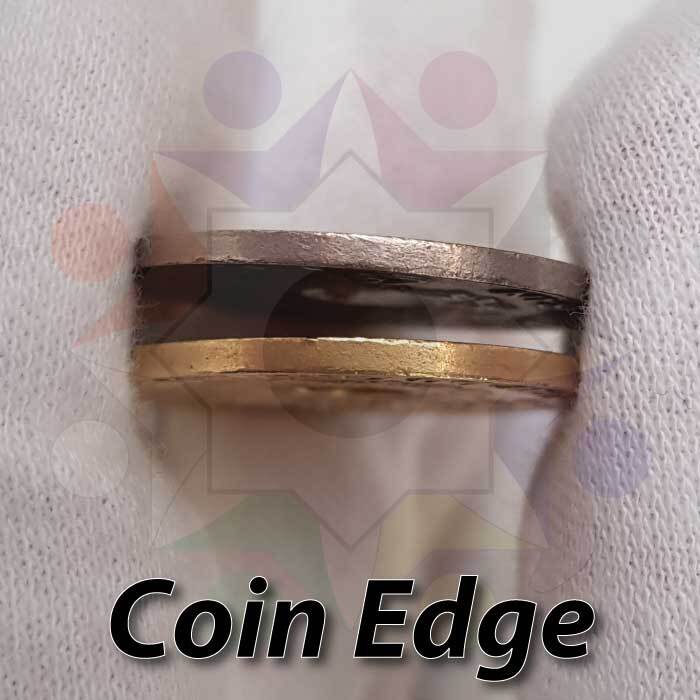 Coin EdgeThe edge of a coin may be plain (smooth), reeded (vertical striations), or lettered (bears lettering or ornamentation). The Edge of a coin is sometimes considered to be its “third side”.